

Dear Readers,
Do life’s hardships overwhelm you and make you feel disconnected from G‑d?
The first parents of our nation present a powerful lesson on how to approach such times. In their advanced years, Abraham and Sarah are told to travel to Canaan.
Canaan, the ancient name for the Land of Israel, also means “merchant.” A merchant symbolizes wealth, bounty, opportunity. Spiritually, too, the name signifies a profound closeness to G‑d. Abraham experiences a closer relationship with G‑d, and is promised that he will inherit Canaan.
But then a challenge appears . . . “There was a famine in the land, and Abram went down to Egypt.”
Spiritually, a famine is a test of faith, when our spirituality becomes dulled.
Abraham instructs Sarah: “When the Egyptians see you, they will say ‘This is his wife,’ and they will kill me. . . . Therefore, please say that you are my sister, so that they will benefit me because of you . . .”
There is a metaphorical, spiritual lesson in these words.
In Canaan, a land of spiritual bounty, Abraham and Sarah live openly as husband and wife, and love each other as only spouses can.
But then Sarah and Abraham end up in Egypt—Mitzrayim, in Hebrew—a name that connotes constraints and limitation. Abraham instructs Sarah to conceal their true relationship and to say that she is his sister.
The relationship of siblings is innate, inborn and constant. The bond with a spouse, however, is chosen; its love is created and is subject to change. That’s what gives the marriage its intensity and passion.
King Solomon speaks of the Jewish people’s relationship with G‑d as being that of both a sister and a wife.
In Canaan, when we are in a space where we feel G‑d’s presence and bounty in our lives, G‑d is our beloved, our spouse.
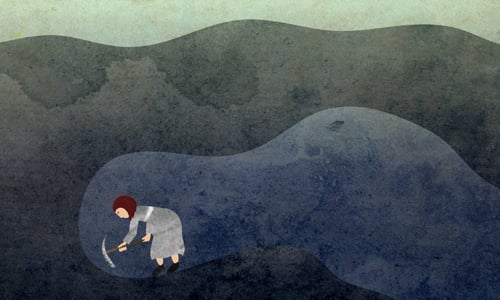
But then a famine arrives. It’s a period of scarcity and challenge, testing our resolve. The relationship becomes strained. We no longer feel the richness, the “merchant” of Canaan. We are in Egypt, a place of meitzarim, of limitations.
Now comes the lesson—“say you are my sister.” Realize that even in moments when you feel disconnected from G‑d, from your nation and from your soul, G‑d is with you. G‑d isn’t only a spouse, but also a sibling.
We are G‑d’s people because G‑dliness is inborn in our being. Like the bond between siblings, it may not always be passionate, but it is always there.
We crave a relationship with G‑d that is alive, vibrant and passionate, like the relationship of a loving spouse. We want to feel like we’re living in the Holy Land, surrounded by spiritual blessings.
But even when we experience our personal famines—times of meitzarim, constraints and hardships—our relationship with G‑d still exists.
And we can always tap into this love and revive it.
Chana Weisberg,
Editor, TJW


You need not look up or down, sideways or any place at all to find the One who cares the very most about you. I am told that there exists a Hebrew word that is sufficent when everyone or else seems to have lost all interest in helping you. It is translated into English as Lord, save me, but it has no limitations as to what you can be saved from.
So, please exit from your deep, and dark coal mine into the Shkihinah glory of the Most High God of Israel. Therein you will find His helping hand. and remember a convert loves you very much.